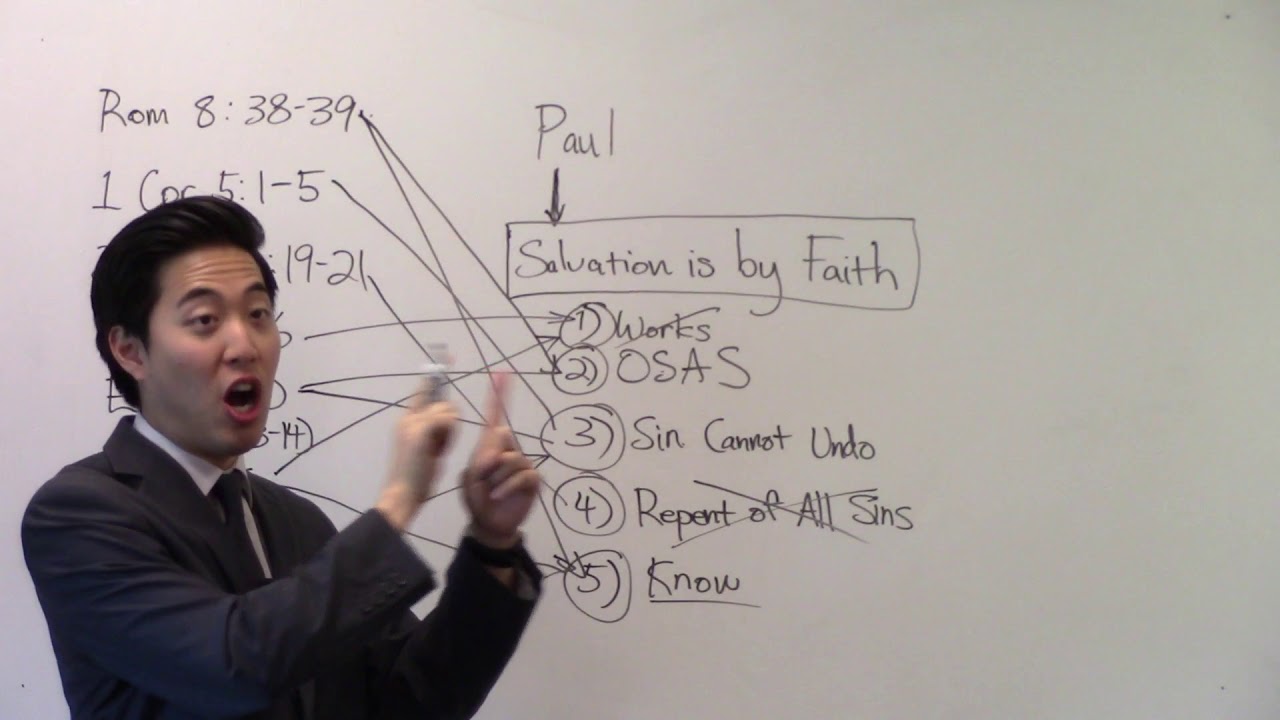
Paul taught a doctrine of salvation by faith without works. Once one is saved by faith, one is saved by faith, and being saved by faith does not include works. If one is saved by faith, then once saved, always saved — sin cannot undo salvation. Being saved by faith does not require that one has to repent of all sins. A lot of people say that one has to have full surrender, full commitment, take up the cross and follow him, repent of all sins — but that’s not what salvation includes.
All Pauline epistles show “once saved always saved”
Romans 8
Catholics teach that one can never know if he is saved. Under “Lordship Salvation”, people sometimes doubt and worry, wondering if he is really saved due to messing up in some really bad area. But Pastor Kim pointed to Romans 8 to disprove this.
Romans 8:38-39 — “For I am persuaded, that neither death, nor life, nor angels, nor principalities, nor powers, nor things present, nor things to come, Nor height, nor depth, nor any other creature, shall be able to separate us from the love of God, which is in Christ Jesus our Lord.”
“For I am persuaded” — Paul knew that nothing in this life can condemn a person. Not death nor life, not angels, not principalities, nor powers, things of this world, nor things present nor things to come. Interestingly, the Bible doesn’t say “past”, it says “present and future,” because after a person gets saved, nothing the person does now or in the future can undo his salvation. Nor height nor depth — not even heaven itself can condemn one, nor death — hell can’t condemn one — nor any other creature, meaning no other person or creature shall be able to separate the believers from the love of God which is in Christ Jesus our Lord. The verse shows that absolutely nothing can separate one from salvation. It also shows that once saved, always saved.
1 Corinthians 5
1 Corinthians 5:1 — “It is reported commonly that there is fornication among you, and such fornication as is not so much as named among the Gentiles, that one should have his father’s wife.”
In this verse, Paul said that this person slept with his father’s wife, something totally messed up and sinful, so one would think that person was lost. But then look at verse 4,
1 Corinthians 5:4-5 — “In the name of our Lord Jesus Christ, when ye are gathered together, and my spirit, with the power of our Lord Jesus Christ, To deliver such an one unto Satan for the destruction of the flesh, that the spirit may be saved in the day of the Lord Jesus.”
When the church is gathered together in spirit with the power of the Lord Jesus Christ, that particular Christian who committed the heinous sin was to be delivered to Satan for the destruction of — NOT his soul, but his flesh — so that the spirit may be saved in the day of the Lord Jesus. The man’s spirit is saved, but his body is turned over to Satan.
After being saved, the body is still wicked. As Paul said in Romans 7, “O wretched man that I am”. The body is not transformed; it’s the spiritual nature that was born again, awakened, and transformed. If one doesn’t think the body is wicked as hell, one will underestimate its power and yield to a lot of temptations that the devil’s going to throw at one. But if one is armed with the thinking that the body can commit the worst kinds of things, one will tend not to fall into those wicked sins and will be better prepared.
2 Corinthians 12
2 Corinthians 12:19-21 — “Again, think ye that we excuse ourselves unto you? we speak before God in Christ: but we do all things, dearly beloved, for your edifying. For I fear, lest, when I come, I shall not find you such as I would, and that I shall be found unto you such as ye would not: lest there be debates, envyings, wraths, strifes, backbitings, whisperings, swellings, tumults: And lest, when I come again, my God will humble me among you, and that I shall bewail many which have sinned already, and have not repented of the uncleanness and fornication and lasciviousness which they have committed.”
It is plain that sin cannot undo salvation. In verse 19, Paul calls these people “dearly beloved”, these are saved people (Ephesians 1 also proves that if a person is saved in Jesus Christ, that person is part of the beloved in Christ).
In verse 20, these are saved Christians committing this list of sins and have not repented of their sins, yet Paul still called them dearly beloved in verse 19. So, these verses rule out the idea that one must repent of all sins for salvation.
Galatians 2
Galatians 2:16 — “Knowing that a man is not justified by the works of the law, but by the faith of Jesus Christ, even we have believed in Jesus Christ, that we might be justified by the faith of Christ, and not by the works of the law: for by the works of the law shall no flesh be justified.”
This is the only verse in the whole Bible that mentions “works” three times — not works, not works, not works. Paul made it very clear: works as part of salvation is ruled out.
Ephesians 1 and 4
If one trusted in Christ for salvation, one is sealed with the Holy Spirit until the rapture. But what if one commits really bad sins — won’t the Holy Spirit leave? Or maybe the Holy Spirit was never there to begin with? No! Because Ephesians 4:30 reads, “grieve not… the Holy Spirit of God” — meaning one’s sinning grieves the Holy Spirit within, but the Spirit doesn’t leave, “whereby ye are sealed unto the day of redemption.” No matter how many times one displeases and grieves God, the seal remains until the rapture. That supports both the idea that sin cannot undo salvation and that once saved, always saved.
Ephesians 1:13-14 — “In whom ye also trusted, after that ye heard the word of truth, the gospel of your salvation: in whom also after that ye believed, ye were sealed with that holy Spirit of promise, Which is the earnest of our inheritance until the redemption of the purchased possession, unto the praise of his glory.”
Ephesians 4:30 (KJV) — “And grieve not the holy Spirit of God, whereby ye are sealed unto the day of redemption.”
Philippians 1
Philippians 1:6 (KJV) — “Being confident of this very thing, that he which hath begun a good work in you will perform it until the day of Jesus Christ.”
This verse addresses the worry that God will leave and the fear that God was never really there, or that God has forsaken someone. “Being confident” — you know you’re saved. It also shows that God performs a good work in you and will carry it out until the day of Jesus Christ. If the works are not showing, that doesn’t mean that person is not saved. God will do the work through the Holy Spirit, convicting of sin, and through his chastening rod to bring that person back to the right path. If a Christian messes up and lives so wickedly, refusing to do the work of the Lord, then God will take that person home early.
Colossians 2
Colossians 2 is one of the favorite passages of Pastor Kim for eternal security. Christians, pastors, theologians, and cults think this is heresy, despite having gone through every single Pauline epistle.
Colossians 2:11, 13 — “In whom also ye are circumcised with the circumcision made without hands, in putting off the body of the sins of the flesh by the circumcision of Christ… And you, being dead in your sins and the uncircumcision of your flesh, hath he quickened together with him, having forgiven you all trespasses.”
Verse 13 says that when one is dead in sins and the uncircumcision of the flesh, God quickened that person together with him, having forgiven all trespasses — so, God saved the person, and the person is now saved.
Then, in verse 11, when one gets saved: “In whom also ye are circumcised with the circumcision made without hands” — God performed a circumcision not made with hands, not physical, but a kind of spiritual, invisible circumcision. Circumcision is the cutting off of a bodily part — “in putting off the body of the sins of the flesh by the circumcision of Christ.” God cut a person out of the body of sins — which is why, no matter what sin one commits in the body, it is not going to be a part of that person or contaminate the soul. That person is cut off, separated from it. That is a blessing, a wonderful doctrine of spiritual circumcision.
1 Thessalonians 4
Many worry about missing the rapture and feel they have to meet certain conditions to be raptured; that is not true. Those conditions refer to a different time period, a different doctrine. Paul says that if one believes in Jesus Christ for salvation, one will be raptured no matter what. That is the condition (believing in Jesus Christ for salvation) for rapture, not certain requirements or works.
1 Thessalonians 4:14, 17 — “For if we believe that Jesus died and rose again, even so them also which sleep in Jesus will God bring with him… Then we which are alive and remain shall be caught up together with them in the clouds, to meet the Lord in the air: and so shall we ever be with the Lord.”
“For if we believe that Jesus died and rose again… will God bring with him” — that means one will be raptured if one believes that Jesus died and rose again. That’s why in verse 17: “Then we which are alive and remain shall be caught up together with them in the clouds…“. A lot of people get terrified of the tribulation, wondering if they will miss the rapture and have to go through the Antichrist’s system, 666, the seven seals, seven trumpets, seven vials — but no, the Bible says the believer is raptured.
2 Thessalonians 2
This is a favorite passage used to argue that one has to go through the tribulation, but it actually shows the opposite — that one will not go through the tribulation but will be raptured. This is meant to be a verse of comfort, not of terror.
2 Thessalonians 2:8 — “And then shall that Wicked be revealed, whom the Lord shall consume with the spirit of his mouth, and shall destroy with the brightness of his coming:”
They claim the Antichrist must be revealed first, and only then does one get raptured — meaning one would go through the tribulation with the Antichrist revealed and be raptured later. But in verses 8 through 12, believers are NOT described there — it’s “them, them, them, them” — others.
2 Thessalonians 2:10-12 — “And with all deceivableness of unrighteousness in them that perish; because they received not the love of the truth, that they might be saved. And for this cause God shall send them strong delusion, that they should believe a lie: That they all might be damned who believed not the truth, but had pleasure in unrighteousness.”
The believers are mentioned in verses 13 to 14, contrasting with verses 8 through 12,
2 Thessalonians 2:13-14 — “But we are bound to give thanks alway to God for you, brethren beloved of the Lord, because God hath from the beginning chosen you to salvation through sanctification of the Spirit and belief of the truth: Whereunto he called you by our gospel, to the obtaining of the glory of our Lord Jesus Christ.”
The above verses describe saved people. “Whereunto he called you by our gospel” — saved by the gospel — “to the obtaining of the glory of our Lord Jesus Christ.” So, while the others go through the tribulation after the Antichrist is revealed, believers are called to glory. Comparing this with Colossians 3:4, being called to glory refers to being raptured up to heaven.
Colossians 3:4 — “When Christ, who is our life, shall appear, then shall ye also appear with him in glory.”
1 Timothy 1
Someone might think there’s no way they could get saved, that they’d have to clean up their life or do good things — but no, it’s simply believing by faith in Jesus Christ.
1 Timothy 1:15-16 — “This is a faithful saying, and worthy of all acceptation, that Christ Jesus came into the world to save sinners; of whom I am chief. Howbeit for this cause I obtained mercy, that in me first Jesus Christ might shew forth all longsuffering, for a pattern to them which should hereafter believe on him to life everlasting.”
So Paul is described as the chief of sinners, and God says he would use Paul as a pattern for people — even the worst of sinners. How does one get saved, what kind of pattern is it — cleaning up one’s life? No — “believe on him to life everlasting.” This shows that all it takes is salvation by faith; works are not included, and it results in life everlasting, once saved, always saved.
2 Timothy 2
With this much evidence across every book of the Pauline epistles, it should be more than enough to convince anyone.
What if one stops believing — is one no longer safe? Not according to 2 Timothy 2, since believers are part of Jesus Christ, Christ cannot deny himself, so even if one stops believing, one is still safe.
2 Timothy 2:13 — “If we believe not, yet he abideth faithful: he cannot deny himself.”
Titus 3
Titus 3:5 — “Not by works of righteousness which we have done, but according to his mercy he saved us, by the washing of regeneration, and renewing of the Holy Ghost.”
The common assumption is that this refers to water baptism — but it’s not true. It’s not water that washes, regenerates, or renews a person; it’s the Holy Ghost. Jesus washed away sins with his blood, not by anyone jumping in a pool. This shows that works (including baptism) are not included for salvation, since some people think being saved by faith includes baptism — but this passage shows it’s neither baptism nor works.
Philemon
Many preachers preach from this passage because it’s a wonderful picture of salvation — that one’s sins are not held to one’s own account, because they are accounted to Jesus Christ.
Philemon 16, 18 — “Not now as a servant, but above a servant, a brother beloved, specially to me, but how much more unto thee, both in the flesh, and in the Lord?… If he hath wronged thee, or oweth thee ought, put that on mine account.”
This verse describes a saved brother in Christ; Paul was covering for a man named Onesimus, a slave who had run away from his master, and Paul is asking the master — also a saved Christian — to forgive Onesimus as a brother in Christ, to count Onesimus as a partner just as he counts Paul as a partner.
This is likened to Jesus Christ speaking on behalf of a runaway slave. Christ intercedes on the person’s behalf, saying to the Father: “If I am your partner, if I am one with you, if you love me — put the love bestowed on me upon that person.” In verse 18, it is a picture of Jesus on the cross of Calvary saying to God the Father that whatever wrong the person has done and owes, put it on his (Christ’s) account instead.
This is a wonderful picture of a person’s works are not being included for his salvation — Jesus did all the work. Once saved, always saved, because it’s on Christ’s account; he covers for the believer. Sin cannot undo it, because the wrongdoing is placed on Jesus Christ, not because the person repents of all sins. A person can be sure of his salvation because Jesus declared he will take care of it: he will take care of the believers, he will rapture them to heaven, he will carry them, and baptism is not required at all.
These are great verses to show that salvation is by faith and not by works.